
Advent of CTF 2025: Day 5 - Kramazon
Day 5 of Advent of CTF 2025 takes us into web application security with an investigation of “Kramazon,” a suspicious e-commerce platform operated by the Krampus Syndicate to disrupt Santa’s delivery network.
Challenge Overview
Category: Web Exploitation
Difficulty: Intermediate
Target: https://kramazon.csd.lol/
Scope: https://kramazon.csd.lol/* only
Challenge Description
Intelligence analysts from the North Pole Logistics Directorate (NPLD) have uncovered a covert online storefront operated by the KRAMPUS Syndicate called Kramazon. This distribution front is used to intercept gifts, reroute sleigh cargo, and undermine Santa’s global delivery network.
The platform contains a critical flaw: customers with ordinary elf-level accounts can somehow receive Santa-priority shipping status, which should only be assigned through Santa’s authenticated sleigh-routing systems.
Mission: Exploit this flaw to obtain Santa Priority Delivery and reveal the restricted Priority Route Manifest containing the flag.
Initial Reconnaissance
Understanding the Application
Kramazon appears to be a typical e-commerce platform with:
- Product catalog
- Shopping cart functionality
- User authentication system
- Order processing workflow
- Shipping priority levels
Identifying the Vulnerability
The challenge description hints at a privilege escalation vulnerability where regular users can gain Santa-level shipping privileges through some implementation flaw.
Solution Analysis
Cookie-Based Authentication Investigation
Initial investigation reveals the application uses cookie-based authentication with a suspicious pattern.
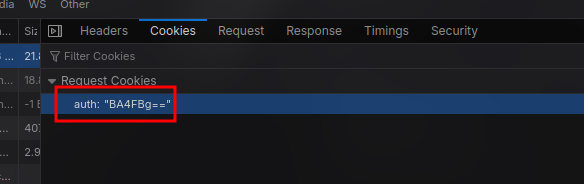
The authentication cookie contains a Base64-encoded value that appears to control user privileges.
JavaScript Analysis
Examining the client-side JavaScript reveals a critical function:
function santaMagic(n) { return n ^ 0x37; // XOR with 0x37}This function suggests that user privileges are controlled through XOR operations with the value 0x37.
Cookie Manipulation Strategy
To gain Santa privileges, we need to find a value n such that:
santaMagic(n) = 1n ^ 0x37 = 1n = 1 ^ 0x37 = 54 (0x36)Implementing the Exploit
Step 1: Delete Existing Cookie
First, we clear any existing authentication cookies:
document.cookie = "auth=; path=/; expires=Thu, 01 Jan 1970 00:00:00 UTC;";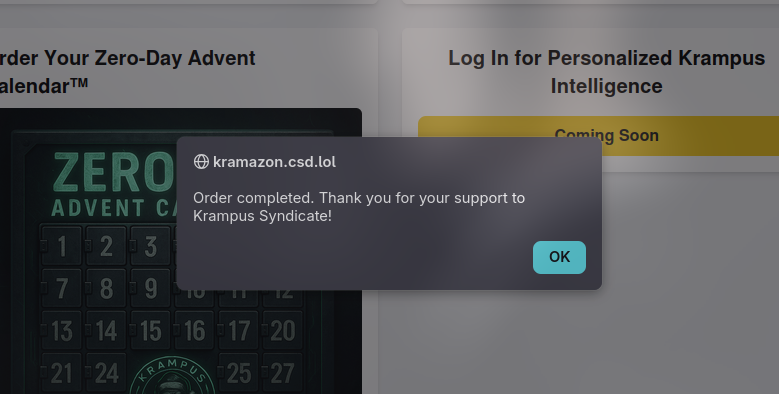
Step 2: Create Santa Cookie
We create a new cookie with the calculated Santa privilege value:
document.cookie = "auth=Ng==; path=/"; // Base64 of 0x36Where Ng== is the Base64 encoding of 0x36 (54 decimal).
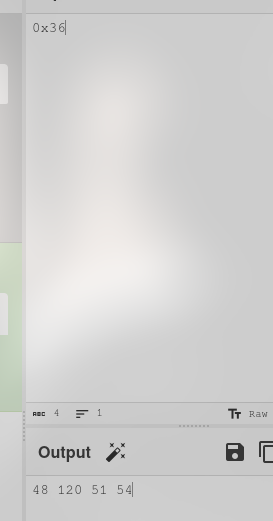
Step 3: Exploit the Workflow
The intended exploitation flow should be:
- Create Order with Santa Cookie: Use
Cookie: auth=Ng== - Verify Privilege Escalation: Check that status responses include
"user": 1 - Finalize Order: Complete the purchase process
- Access Priority Manifest: Gain access to restricted content containing the flag
Technical Analysis
XOR-Based Privilege System
The vulnerability lies in the client-side XOR function that determines user privileges:
// Normal user: santaMagic(someValue) = 0// Santa user: santaMagic(54) = 1function santaMagic(n) { return n ^ 0x37;}Base64 Encoding Chain
The privilege value goes through this encoding chain:
- Decimal Value: 54
- Hexadecimal: 0x36
- Base64: Ng==
- URL Encoded: Ng%3D%3D (if needed)
Cookie Structure
The authentication cookie structure:
auth=<Base64-encoded-privilege-value>Where the decoded value determines user privileges through the XOR function.
Key Learning Points
This challenge demonstrates several important web security concepts:
Client-Side Security Flaws
- Never trust client-side validation for security decisions
- Privilege determination should always happen server-side
- Cookie manipulation is trivial for attackers
Cryptographic Weaknesses
- Simple XOR operations provide no real security
- Predictable algorithms can be easily reversed
- Client-side crypto is fundamentally flawed for security
Web Application Architecture
- Separation of concerns between client and server
- Proper authentication mechanisms using secure tokens
- Server-side validation of all security-critical operations
Defensive Recommendations
To prevent similar vulnerabilities:
- Server-Side Validation: All privilege checks must occur server-side
- Secure Session Management: Use cryptographically secure session tokens
- Principle of Least Privilege: Users should have minimal necessary permissions
- Input Validation: Validate and sanitize all client inputs
- Security Testing: Regular penetration testing of authentication mechanisms
Real-World Applications
This type of vulnerability is common in:
- E-commerce platforms with flawed privilege systems
- SaaS applications with client-side role determination
- Mobile applications trusting client-side data
- Legacy systems with outdated authentication mechanisms
Challenge Limitations
During testing, the expected server behavior (including "user": 1 in status responses) was not consistently observed, suggesting either:
- Implementation differences from the description
- Additional conditions or steps required
- Potential challenge environment issues
However, the core vulnerability concept remains valid and educationally valuable.
Tools and Techniques
Browser Developer Tools were essential for:
- Cookie manipulation and inspection
- JavaScript analysis and execution
- Network request monitoring
- Response analysis
Conclusion
Day 5 highlights critical web application security principles, particularly the dangers of client-side security decisions. The Kramazon challenge demonstrates how seemingly minor implementation flaws can lead to complete privilege escalation.
Understanding cookie manipulation, client-side cryptography weaknesses, and proper authentication mechanisms is essential for both offensive security testing and defensive application development.
The challenge serves as an excellent reminder that security must be built into the server-side architecture, not relied upon through client-side controls that attackers can easily manipulate.
This writeup is part of my Advent of CTF 2025 series. Web application security challenges like this one teach fundamental concepts that apply to real-world penetration testing and secure development practices.
Next reads
View all →21 Dec
Advent of CTF 2025: Day 1 - The Mission Begins
A beginner-friendly cryptography challenge involving multi-step encoding conversion using CyberChef to decode binary data into the final flag.
21 Dec
Advent of CTF 2025: Day 2 - The First Strike
Network forensics challenge analyzing FTP traffic to identify compromised credentials during a Krampus Syndicate intrusion attempt.
21 Dec
Advent of CTF 2025: Day 3 - Syndicate Infrastructure
Advanced DNS reconnaissance challenge involving SPF and DKIM record analysis to uncover hidden infrastructure used by the Krampus Syndicate.
Get posts by email
One email when I publish, not a drip, not weekly. Sign up and I'll only write when there's something new.
You won't get mail just for signing up. Unsubscribe any time.